Most AI tools underperform at work because they lack context, not because the model is weak. What the 2026 Work AI Index shows about closing the gap.
Picture the finance manager at a mid-sized firm. She uploads last quarter’s numbers to an AI assistant, reads back a tidy summary, forwards it to the CFO, and heads home. On Monday, three of the figures do not match the spreadsheet they came from. The easy assumption is that the AI made them up. It didn’t. It answered the only way it could, with the narrow slice of the picture it was actually given.
That small failure is the AI productivity paradox in miniature, and it is the seat a lot of Australian business owners are sitting in right now. The 2026 Work AI Index found that 87% of digital workers use AI at work and three quarters say it makes them more productive, saving them around eleven hours each a week. Yet only 13% say their organisation is performing meaningfully better for it. The reason is not that your people are using the tools badly. It is that the tools are working half-blind, and the finance manager’s Monday is what that looks like up close.
More than half of workers, 53%, say the information they actually need to do their jobs is not reachable through their AI. The model can write, reason, and summarise well, but it cannot see the CRM, the accounting system, last year’s contracts, or the email thread where the real decision was made. So it does what any capable assistant does with half a brief. It gives you something confident and polished that is partly wrong, and a person has to catch it.
Access is not the same as context
This is where a lot of AI budgets quietly go to die. Giving an AI access to your data is not the same as giving it context. The finance manager’s firm had handed their assistant a login to the shared drive, so it could open any file it liked. What it could not do was tell which version of the budget was current, which client a figure belonged to, or what the firm treats as a right answer. A login is access. Knowing all of that is context. Most companies buy the first and assume it hands them the second.
It doesn’t, and there is a harder truth underneath. Context does not fix bad data, it just lets the AI reach more of it. If your records are messy, connecting a capable model to them faster only helps it be confidently wrong at a larger scale. The firms that get real value from AI treat the quality of what the AI can see as seriously as the cleverness of the model. That groundwork is what AI agents need to be useful rather than merely impressive.
The hidden cost of botsitting
When the AI cannot see what it needs, the work does not disappear. It lands on the worker. The report gives that hidden labour a name, botsitting, and a price. The average digital worker now spends about 6.4 hours a week feeding AI the context it lacks, checking its output, and fixing its mistakes by hand. At the finance manager’s firm, that meant she was quietly losing most of a day each week to reloading background, correcting figures, and reconciling what the AI produced against the actual books.
A lot of that time is pure friction. She is one of the third of workers now juggling four or more AI tools, and 77% use several every week. Every switch from one tool to the next drops whatever context the last one had built up, so she keeps re-explaining the same things. The person becomes the integration layer, copying and pasting between systems that were never introduced to each other.
That cost does not stay quiet. For every ten percent more of their time workers spend feeding context to AI, they are twenty-five percent more likely to report feeling worn out by it. Unbudgeted, unrewarded grunt work turns into resentment, and eventually into resignation letters. The finance manager did not sign up to be the firm’s AI wrangler, and she will not do it forever.
The businesses pulling ahead
The firms that fix this pull away from the ones that don’t, and the gap is not subtle. Workers in what the report calls context-rich organisations, the ones whose AI can actually reach the information the work depends on, are 64% less likely to feel worn out by AI, 52% less likely to ship work they cannot explain, and 31% less likely to push unchecked output downstream. That return comes not from a cleverer model but from a better-fed one.
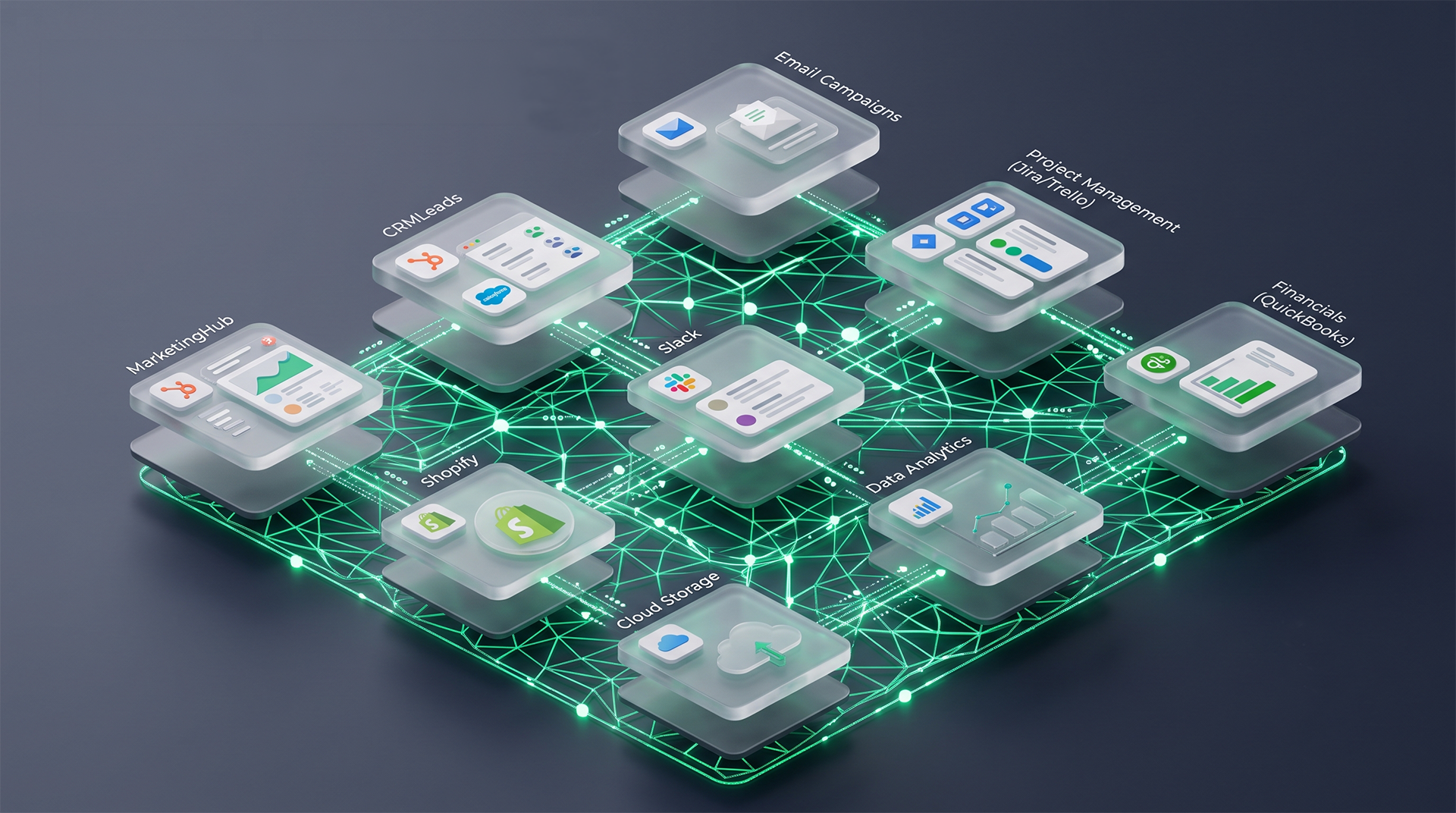
That is the road the finance manager’s firm took. They stopped adding tools and connected the two systems that mattered, the accounting file and the CRM, to a single grounded assistant built on Gemini, with clear limits on what it could see and use. Because those systems hold customer and financial records covered by the Privacy Act 1988 and the Australian Privacy Principles, they opened them deliberately rather than all at once. Within a couple of months the Monday reconciliation was mostly gone, and the finance manager had her week back.
Smaller businesses feel the original problem most sharply, even though the survey did not single them out, because they are the least able to absorb it. A large enterprise can put a data team on wiring its systems together. In a smaller firm that wiring rarely exists, so the job of human glue falls to the owner or the one operations person who already carries everything else. The tool gets adopted. The plumbing never does. The upside is that the fix is smaller too. You are not building an enterprise data platform, you are connecting the handful of systems that actually matter.
What this means for you
If your AI results have been disappointing, the move is not to buy more AI. It is to look honestly at where the AI is guessing because it cannot see, and to close those gaps one at a time. Start with the work, not the tool. Find the few moments where a person is quietly handing the model context it should already have, and connect it properly. One honest caveat before you do. This will not rescue a broken process, and a person still has to own the answer that goes to the CFO. Connecting your systems makes a good team faster, it does not make judgement optional.
The companies winning with AI right now are mostly not running smarter models than everyone else. They are running ordinary ones with a much better idea of what those models are allowed to know. If you want to find where your own AI is working half-blind, our AI Roadmap Interview is a straightforward place to start. You talk through your team’s goals and the places you lose the most time, and you walk away with a custom plan for where to begin.