Gemini's new Interactions API lets AI agents take real actions, not just chat. What agentic AI means for Australian SMEs and where to start safely.
For a few years, AI in the office meant a chat window. You asked a question, you got an answer, and then you still did the work yourself. Google’s recent move to make the new Interactions API the default interface for Gemini agents changes the shape of that. The headline for developers is better support for asynchronous execution, tool use and managed autonomous agents. The headline for a small business owner is simpler. An AI agent can now take a concrete action on your behalf. It can book the appointment, check the inventory, process the refund and email the receipt, rather than telling you how to do those things.
This piece looks at agentic AI from the seat of an Australian SME deciding whether the technology is real yet, not from a tech giant with a research division. The short answer is that it is real. The skill, as always, is choosing where it earns its keep first and keeping a person accountable for the actions that matter.
What agentic AI actually changes
The difference between a chatbot and an AI agent is the ability to use tools. A chatbot generates text. An agent can call your booking system, query a stock database, hit a payment provider or send an email, then read the result and decide what to do next. The Interactions API matters because it makes that loop of act, observe and act again the default way of building, with proper handling for tasks that run in the background rather than blocking while a customer waits.
There is a second shift worth understanding, because it changes how you should think about cost and reliability. The serious work is moving toward orchestrating several models for one task rather than relying on a single large model to do everything. A fast, cheap model triages an incoming request. A stronger model handles the tricky reasoning. A narrow tool does the database lookup. The agent coordinates them. For an SME this is good news, because you are not paying premium model rates for every trivial step, and you can swap any one piece without rebuilding the whole thing.
The contrarian point is that agents do not make the underlying systems any better. If your booking logic is messy or your stock data is wrong, an agent will just make the wrong decision faster and at scale. Agentic AI rewards businesses that already have clean processes and punishes those that do not. So the honest first task is often tidying the workflow you are about to hand over, not buying the agent.
Where to start
Start where the work is repetitive, rules-based and high volume, because that is where an agent is both safe and easy to measure.
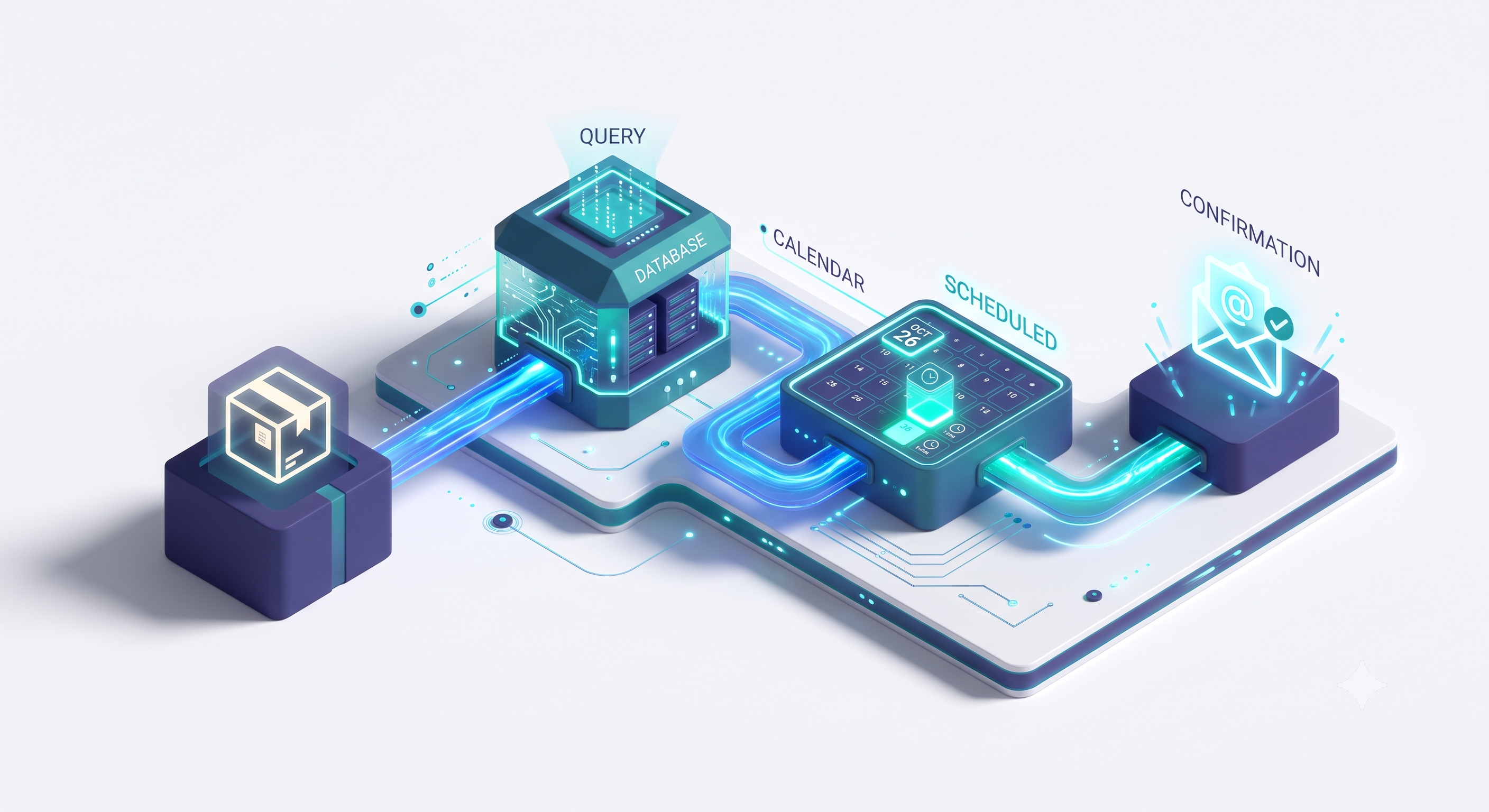
For a professional services firm, a good first agent handles client intake and scheduling. It reads an inbound enquiry, checks the right person’s calendar, books a consultation, sends the confirmation and logs the matter. The same pattern extends to chasing missing documents or drafting routine status updates. These are the slow, low-judgement tasks that clog a small team, and they are exactly the sort of work AI agents for professional services are suited to, with a person reviewing anything that touches advice or billing.
For a retail or trades business, the early win is usually stock and orders. An agent can check inventory when a customer asks, flag when a line is running low, draft a reorder, and send a receipt once a sale closes. Tie it to your existing point of sale and accounting tools rather than a new platform, so the actions land in the systems your team already trusts.
The implementation discipline is the same in both cases. Map the workflow as it runs today. Decide which steps the agent may complete on its own and which need a human to approve. Give it the narrowest set of permissions that lets it do the job. Run it in parallel with your current process for a few weeks so you can compare. If a fully automated booking saves, say, an illustrative ten minutes per request across a hundred requests a week, you will see it in the numbers quickly. That figure is only an example to show how to measure, not a published result. The point is to measure your own before-and-after rather than trust a vendor’s claim.
The Australian reality
This is where agents differ from a harmless chat assistant. The moment an agent can act, it can also cause harm, because it is now spending money, sending things to customers or changing records. That raises the governance bar.
The safe pattern is to keep a person accountable for any action with a financial or compliance consequence. An agent can prepare a refund, but a person should approve it past a threshold. An agent can draft an invoice, but the figures still have to be right under your tax obligations. An agent that emails customers is handling personal information, so the Privacy Act 1988 and the Australian Privacy Principles apply to what it collects, stores and sends. If you operate in a regulated field, the agent does not change your obligations under that regime. It just does the legwork up to the point a person signs off.
Two practical controls make this manageable. First, log every action an agent takes, so you have an audit trail when something goes wrong, and assume that eventually it will. Second, set hard limits on what the agent can do unsupervised, such as a dollar ceiling on any single transaction or a rule that customer-facing emails on sensitive matters go to a person first. None of this is exotic. It is the same accountability you would expect of a new staff member, written down and enforced by the system.
What this means for you
Agentic AI has crossed from demo to useful, and the Interactions API for AI agents built on Gemini is part of why. The businesses that benefit are not the ones chasing the most ambitious autonomous setup. They are the ones who pick a single repetitive workflow, hand the safe steps to an agent, keep a person accountable for anything that moves money or carries a legal weight, and measure the result honestly over a month.
If you want to understand the technology behind this, the Gemini page covers the model side, and our work on agents covers the build, the tool wiring and the governance that keeps it safe. Start narrow, keep a human in the loop where it counts, and let the wins compound from there.