AI amplifies the process it lands in. The evidence from software shows why speeding up one step rarely speeds up the business, and what to check first.
The hype around AI is that it is as a way to make work faster. The research that measures it carefully keeps landing somewhere narrower and more useful, AI amplifies the process it lands in. A tidy process gets quicker, and a messy one gets messier faster. That concept comes from DORA, not from us. Their 2025 report, drawn from around 5,000 professionals, concluded that AI acts as an amplifier, magnifying the strengths of high-performing organisations and the dysfunction of struggling ones. The finding comes mainly from software teams, because software is where this has been integrated and measured most closely so far, but nothing about it is specific to code.
So if you’re being told AI will lift your output, the honest answer is that it will lift output at the one step you point it at. Whether that turns into value for the business depends entirely on whether that step was the thing holding you up.
What happens when you speed up one step
The software evidence splits along a clean line. Studies run by the companies selling the tools find gains of 21% to 56%, measured on small, self-contained tasks with a clean starting point. Independent studies that measure the whole system, doing real work in established codebases, find something else.
The most careful of them came from METR, a nonprofit that takes no funding from AI vendors. They gave 16 experienced developers 246 real tasks in code they had worked on for years. With AI tools allowed, the work took 19% longer. Going in, those developers had predicted AI would make them 24% faster, and after finishing they still believed it had made them 20% faster. That 43-point gap between what people felt and what actually happened is the part worth sitting with, because most confidence about AI productivity rests on exactly that kind of self-report. The system-level numbers tell the same story. Faros AI looked at telemetry from 1,255 teams and more than 10,000 developers. High-adoption teams pushed through 98% more work, and at the same time their review time rose 91%, their changes grew 154% bigger, and bugs per developer rose 9%. There was no significant correlation between AI adoption and improvement at company level. Meanwhile the share of code rewritten or thrown out within a fortnight of being written has climbed from 3.3% before these tools to 7.1% in 2025. More got produced, and less of it stuck.
The same shape exists in a business that writes no code
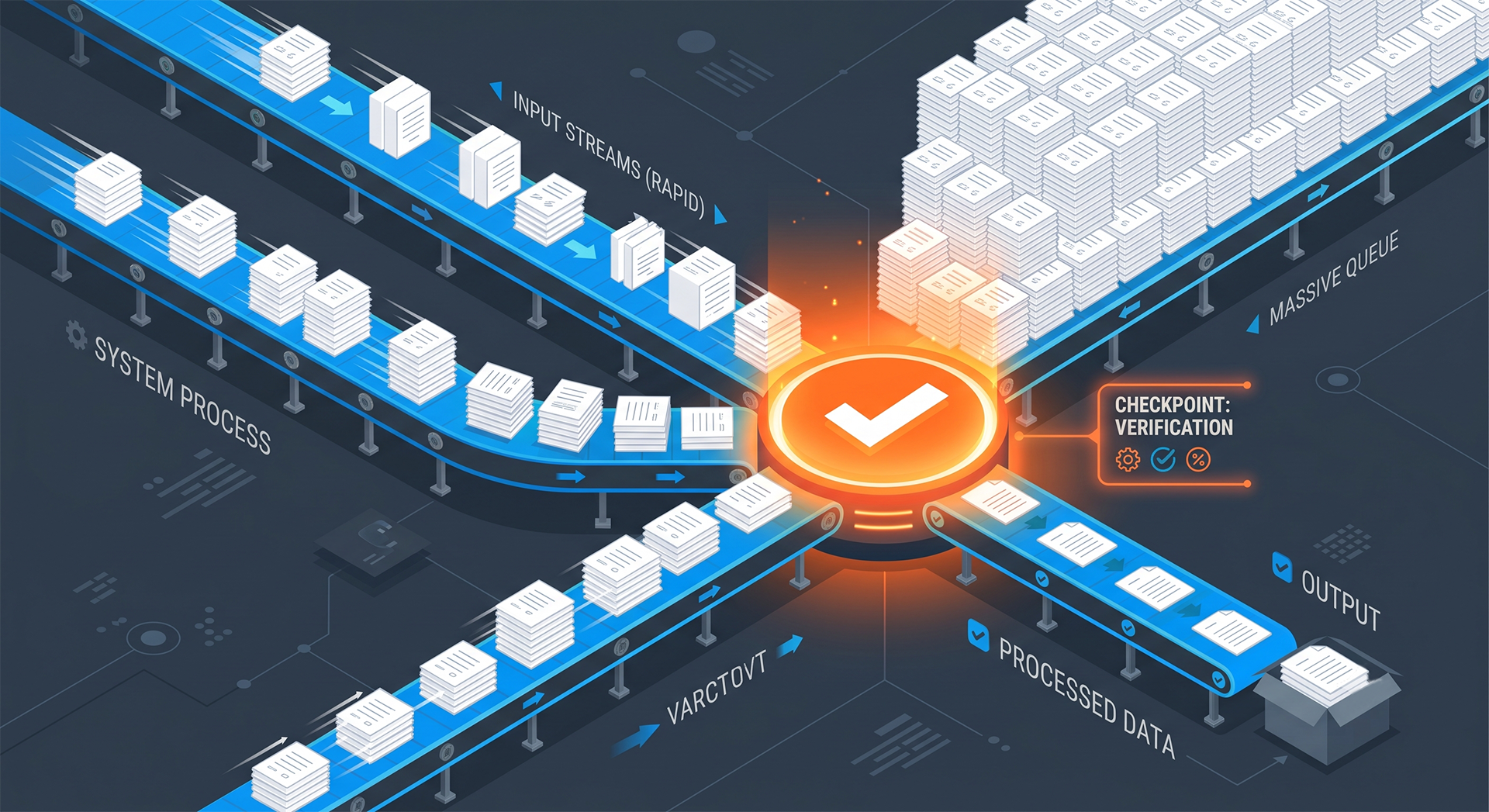
Earlier this year we worked with a building products supplier in Melbourne sending out around 40 quotes and tenders each week. The sales team started drafting them with AI, and drafting time dropped by more than half. Every quote still went to a human estimator, who checked pricing, stock, and lead times before anything left the building. Within six weeks the queue in front of him had doubled.
Work sitting in that queue isn’t progress. It’s stock on a shelf, costing something while it waits, which is the point quality engineers make when they call unshipped work a liability rather than an asset. The queue also changed how the check got done. People tend to skim when the pile is high, and AI output invites skimming because it reads well and looks finished. Two quotes went out with the wrong lead time, and the rework landed back on the estimator who was already the slow point. Nothing there was an AI failure. The drafts were fine. The business had made its fastest step faster and left its slowest step exactly where it was.
What has to be true before you speed something up
Research on AI coding tools sets out four things an organisation needs before these tools help rather than hurt, these are, reliable automated testing, a well-structured system, a mature, documented processes, and people who are experienced and trained enough to adequately judge the output. The estimate is that 1% to 3% of organisations have all four. The testing figures alone explain why. Only about 5% of companies test fully automatically, and 82% of quality professionals still test by hand every day.
Outside software the equivalent is simpler to say and just as rare. You need to know where work actually queues in your business. You need a check that catches errors without depending on one person reading every line. And you need someone who can tell the difference between output that’s correct and output that only looks correct.
Be clear about what AI won’t do here. It won’t find your constraint for you, and it won’t naturally do the smallest amount of work a job needs. Amazon’s researchers note that reasoning models can produce seven to ten times as many tokens as necessary on simple tasks, and that unnecessary verbosity is estimated to waste tens of millions of dollars a year in computation. Pointed at everything, AI costs you money as well as attention.
What this means for you
Find the constraint before you choose the tool. That’s unglamorous work, and it’s the difference between AI paying for itself and AI quietly making more of something nobody was waiting on. It’s also where process optimisation starts, by following one job through your business and finding where it sits still.
Often, the answer is that AI belongs at the check rather than the drafting, or a different model and process at both. Had the building products warehouse in the example moved it to the checking step, using AI to verify pricing and lead times against the source data, they would have gained efficiencies at multiple steps and would have avoided the queuing problem all together. That kind of work needs proper constraints around the AI so it can’t quietly go past what you asked, which is what agent harnesses are for. A person stays accountable for what goes out the door.
If you’re weighing up where AI fits, take our AI Roadmap Interview. You’ll talk through your team’s goals and where the work piles up, and you’ll get a plan that starts at the step that’s actually costing you.