AI can automate much of your business, but it can't run it. The people who know your customers are what keep your work valuable.
AI has a job-loss story attached to it, and it’s loud. Dario Amodei, who runs the AI company Anthropic, has warned that AI could wipe out up to half of all entry-level white-collar jobs. Meta recently cut 8,000 roles. Ken Griffin of Citadel put it bluntly: “These are not mid-tier white collar jobs. These are like extraordinarily high-skilled jobs being, I’m going to pick a word, automated by agentic AI.” If you run a business here in Australia, that’s an unsettling backdrop. So let’s be plain about what’s actually happening. AI can take over a great deal of the routine work in your business. It cannot run the business for you. The part it can’t do turns out to be the part that matters most, which is knowing your customers and deciding what they’ll actually value.
The company Every, a US media and software business, is a useful test case. They’ve automated everything they can, across coding, writing, design, and customer service. And yet they report more human work to do now than ever. They’re a team of almost 30 people, and they haven’t swapped them out for agents. That’s not a failure of the technology. It’s a clue about how it really works.
Why AI still needs your people
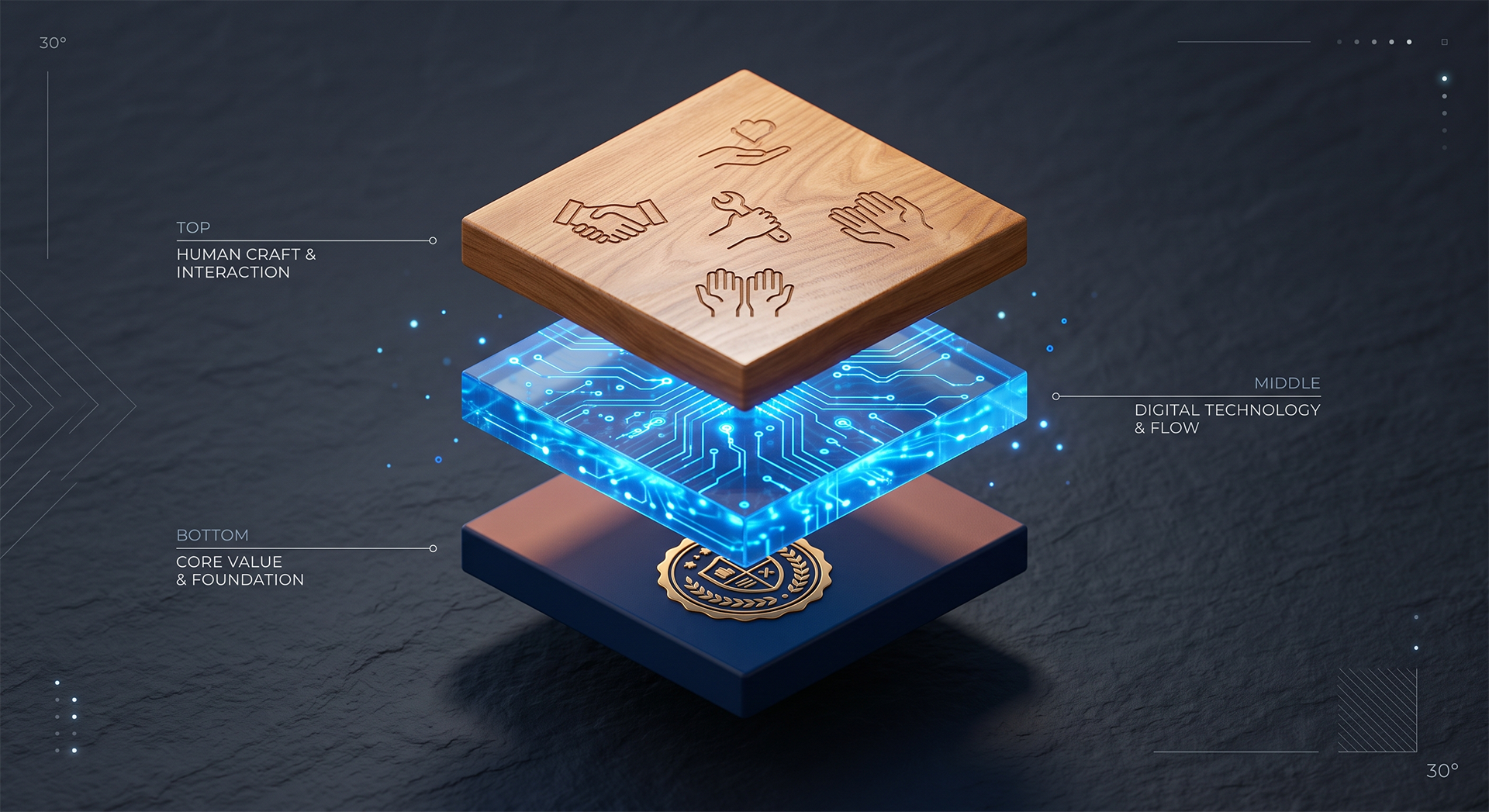
Think about how any piece of work actually gets done. Someone decides it’s worth doing. Someone shapes what “good” looks like. The work happens. Then someone checks it, judges it, and decides what happens next. AI is very good at that middle stretch. It’s the part in between that it can take off your hands. But it can’t start the work on its own, and it can’t tell you when the work is truly finished. It needs a person at the front to point it at the right thing, and a person at the end to say yes, this is right, or no, do it again. Every call this the “human sandwich”, where the people are the bread on either end of the AI’s work. You can think of it as middle-to-middle. The machine handles the middle. Your people hold both ends, and often stay involved through the middle too.
This is why the idea of a business that runs entirely on AI doesn’t hold up, at least with the models we have now. They need a person to confirm that what they’re doing is right, rather than working that out alone. Take that person away and the work drifts. The same is true of the AI agents that get all the attention right now. They’re capable, but they act on behalf of a person. They don’t decide, on their own, what’s worth doing.
Picture a small travel agency. The story and the numbers here are illustrative, meant to show the shape of the change rather than report a real result. Their planners used to lose about two days a week each to building itineraries by hand, checking flight times, and typing out the same day-by-day plans. AI can draft all of that in minutes. So they let it. The first pass of an itinerary now writes itself.
The trap of good enough
Here’s the catch, and it’s the one most businesses will walk straight into. Everyone has the same AI. Your competitor down the road is using the same models you are. If you all point them at the same job with the same rough instruction, you all get back much the same thing. Every have a word for what that produces at scale: slop. Not one bad mistake, but a flat sameness, repeated everywhere.
And sameness is cheap. The moment everyone can produce a decent version of something, a decent version stops being worth much. What people pay for is the thing that fits them exactly. Every make this point well: AI turns yesterday’s expertise into something almost anyone can buy cheaply, which only raises the value of what’s different. Difference is what your customers actually pay for.
This hits service businesses hardest, the accountants, agencies, and advisers whose whole value is judgement. Back to the travel agency. The AI can draft a perfectly fine trip. What it can’t know is that this particular couple hates crowds, travels with a fussy eater, and remembers small touches for years. It doesn’t have the taste to tell a good-enough trip from one this client will talk about for a decade. Your planners do. That knowledge is your edge, and it lives in your team, not in the model.
What to do with the time you get back
When people hear “more efficient”, they tend to hear “fewer staff”. Make a process leaner and you can run it with less, so surely that means fewer people. That’s one option. It’s not the only one, and often it isn’t the best one. If AI gives your team hours back, you can also just do more with them. Take on more clients. Open a new service. Or, quietly the strongest move, put that time straight back into what your customers value. Keep your price where it is, let AI lower what it costs you to deliver, and spend the difference making the work genuinely better. The customer pays the same and gets more. That’s how a client becomes hard to lose, and no model can tell you how to do it. Your people can, because they know what “more” means to that customer.
The travel agency does exactly this. Freed from the itinerary admin, the planners spend that time on the parts a client remembers, like the restaurant booked for a quiet anniversary or the timing built around a toddler’s nap. Same price. A trip worth coming back for. After a few months, more of their clients were booking the next trip before they’d unpacked from the last one.
None of this removes your responsibility, which is worth saying plainly. If an AI tool handles your customers’ personal details, you’re still accountable for them under the Privacy Act 1988 and the Australian Privacy Principles. The judgement calls, the ones that decide whether a customer stays, stay with your team. That’s the point.
What this means for you
AI is worth adopting. It can clear the routine work that’s eating your team’s week, and it can do it now. But clearing that work is the start, not the finish. The businesses that come out ahead won’t be the ones that cut hardest. They’ll be the ones that keep the people who understand their customers, and aim all that freed-up time at delivering more of what those customers value.
The hard part is working out where AI fits in your business, and where it doesn’t. That’s exactly what our AI Roadmap Interview is for. You talk through your team’s goals, your customers, and where the time goes, and you get a plan built around your business for where to start. Take the AI Roadmap Interview, and start there.