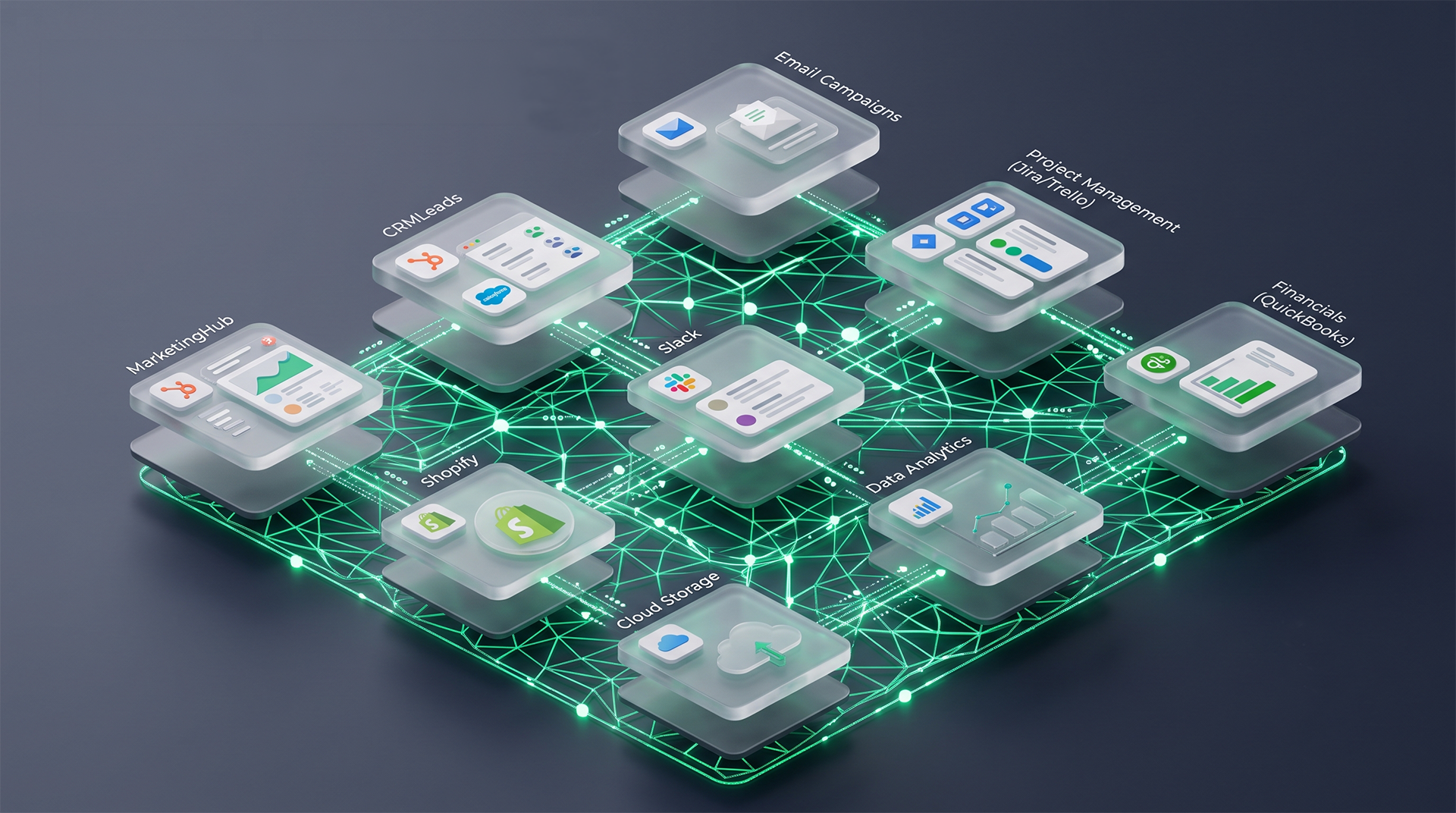
Australian workers lose hours every week switching between tools. The real value of AI agents is that your people stop carrying that load.
AI gets sold on price, or efficiency, or that it will transform your business. An agent does the task for cents in seconds, a person does it for dollars in hours, and the pitch writes itself. That part is real, but it’s the smaller half of the story. The bigger cost sitting in your business is what happens to your people when they’re pulled across six things at once. Asana’s Work Innovation Lab surveyed 13,066 knowledge workers across six countries in 2024, including 2,015 here in Australia. It found that 53% of their time went to busywork, chasing the status of work, searching for information, and communicating about work. That leaves 47% for the skilled, strategic, and value creating work they were hired to do. Break that down and the pattern is clear. Workers lost 9 hours a week looking for information they needed, 6 hours switching between collaboration tools, and another 4 hours just deciding which tool to use. Australian workers reported the same 6 hours a week of switching, on top of 8.3 hours lost to unproductive meetings.
The switching tax costs more than the clock shows
Time is the part you can measure. The part you feel is heavier. Research summarised by the American Psychological Association found that the brief mental blocks created by shifting between tasks can cost as much as 40% of someone’s productive time, and that the cost climbs when the tasks are complex or unfamiliar. Which is to say, it climbs exactly when the work matters most.
Then the errors start. A Qatalog study with Cornell University’s Ellis Idea Lab found people were losing 59 minutes a day hunting for information buried in different apps, 48% were making mistakes because they couldn’t keep track of what was happening across their tools, and 44% couldn’t tell whether a colleague had already done the same job. We have previously worked with a 40-person engineering consultancy in Brisbane. One project coordinator sits at the centre of the business and organises everything, but quotes sit in one system, site-notes in another, project management tasks in a third, and stakeholders asking for a status update every hour. She’s good at her job. She just never gets a clear run at it.
That’s where the second-order costs come from. In the Asana survey, 75% of workers reported digital exhaustion, up from 64% the year before, and 63% said too many tools get in the way of their work. More than half, 53%, said their team leans on a few high performers to get things done, which burns those people out. Lose your coordinator and you don’t just lose a role. You lose everything she knew about how the place runs.
What changes when an agent carries the switching
An AI agent is different from a chat session in one way that matters. A chat session answers your question and hands the work straight back to you. An agent takes an outcome you require, plans the steps, works across your systems, and comes back with something finished. The gap is measurable. Perplexity’s research team compared its agent against its search product on 10,000 matched tasks. The agent ran about 26 minutes of machine work per session against 33 seconds for search, cut estimated task time by 87% and estimated cost by 94%, and quality held up. Meaningful dissatisfaction on follow-up turns was 1.3% for the agent against 2.9% for search. Their summary of the shift is the useful line: the user moves from operator to supervisor.
OpenAI saw the same thing inside its own company. By May 2026, more than 70% of users were asking its agent to complete tasks that would take a person over an hour, and adoption grew fastest among non-developers. Agents, as OpenAI put it, lower the cost of moving across task boundaries. That’s the benefit worth buying. Back at the consultancy, the agent watches the inbox, pulls the job details together from the systems they already use, drafts the supplier follow-up, and assembles the weekly status view. Nothing goes out until the coordinator says yes. She’s still accountable for the judgement. She just isn’t the one holding seven half-finished things in her head at four o’clock on a Thursday.
Where this goes wrong
Two honest warnings, because this is oversold constantly. The first is that most of the work isn’t the AI. MIT Sloan reported on research by Kate Kellogg and colleagues into an agent deployed in a clinical setting, where 80% of the effort went to unglamorous data engineering, stakeholder alignment, governance, and workflow integration. Agents don’t fix messy data. They run on it faster. The second is that the saving isn’t a wage saving, and Kellogg says so directly, “Just because an agentic AI model reclaims 20% of someone’s time, that doesn’t mean it’s a 20% labor-cost savings.” Treat the gain as capacity returned, not a headcount line. There are limits worth naming too. MIT Sloan’s reporting notes that agents struggle with the exceptions humans handle easily, and that organisations need to be clear about who is responsible when an agent gets something wrong. Monitoring is an ongoing cost, not a one-off project. And as soon as an agent touches customer records, your obligations under the Privacy Act 1988 and the Australian Privacy Principles are still yours. Nothing about automation moves them.
Perplexity’s own data reflects the sensible version of this. Around 13% of its agent sessions paused to ask the user for approval or clarification, against 0.3% for search. A good agent runs on its own most of the way, then stops and checks.
What this means for you
The case for AI agents isn’t that they’re cheap (which they are). It’s that they absorb the switching, so the people you’ve spent years training get their attention back. Asana found that in organisations where employees reported lower exhaustion, workers were 69% less likely to say an overload of tools got in the way of their work, and the report draws the line plainly, with less context switching, there’s more capacity for meaningful work.
Start with one job where your team switches most and the steps are well understood. Get the data behind it clean, keep a person accountable for the output, and measure the hours it gives back before you widen the scope. That’s the sequence, and the groundwork is where most businesses underestimate the effort.
It’s also the part you don’t have to work out alone. Have a look at how we work as a technology partner, from the strategy through to the build, every month something new in your business gets more efficient, think of the compounding returns. Getting the first one right is what makes the second one easy.