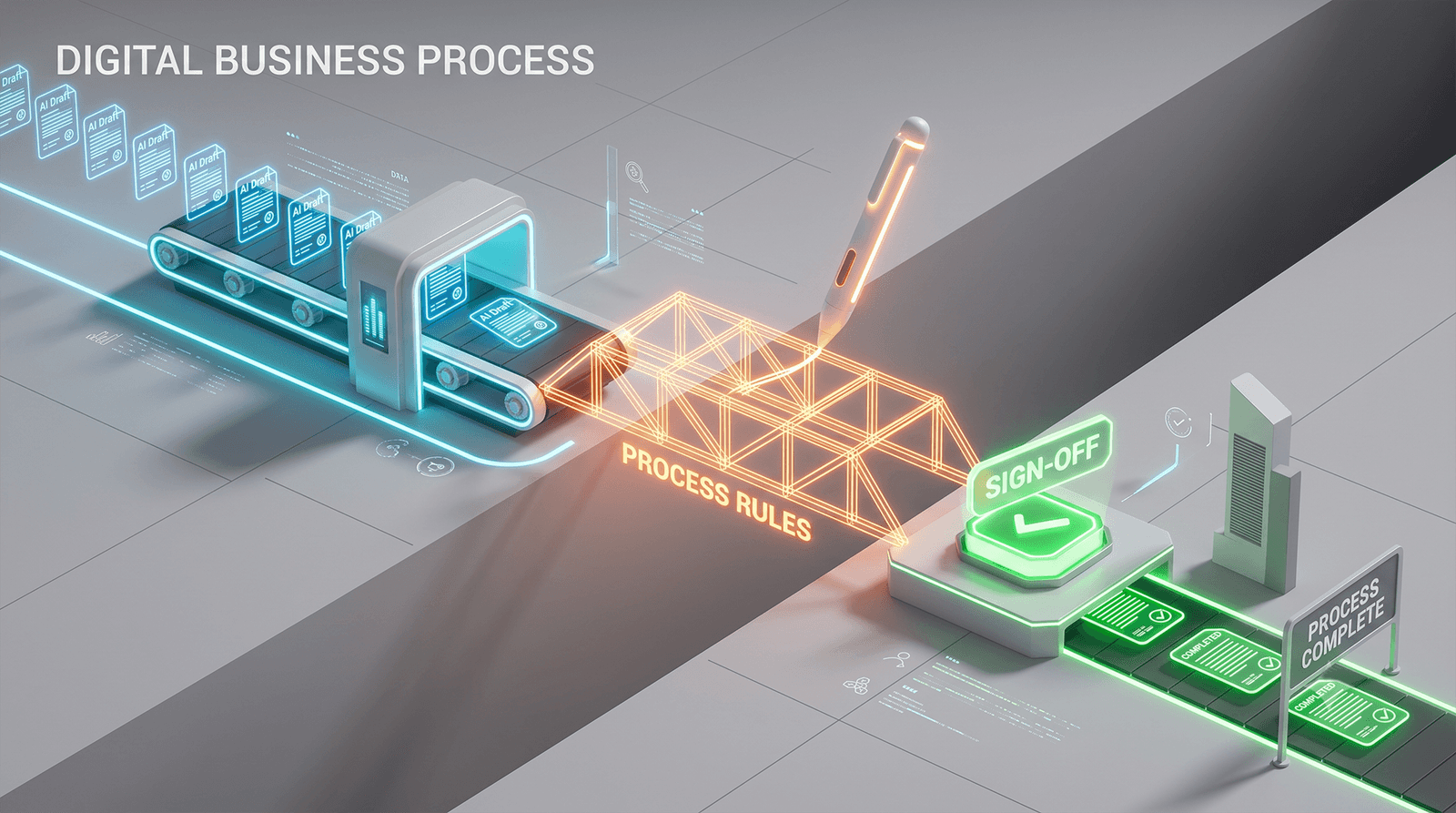
Off-the-shelf AI finishes a task and hands the job back. Closing the loop starts with documenting the work your people do without thinking.
AI is basically in a perpetual state of being oversold, so let’s be plain about what off-the-shelf tools can and can’t do. They finish part of a task. They don’t finish a job. Your team can already ask a chat interface to summarise a long email chain or draft a reply, and it does that well. But something still has to happen next. Someone reads the summary, works out what it means, then goes and does the four things that actually move the work forward. The tool did half the task and then handed the job back. That handback is where your hours go, and no amount of extra features inside a subscription product will close it, because the product was never built to touch the way your business runs.
If you run a growing Australian business, that gap is probably the biggest thing standing between you and a real efficiency gain with AI. The fix isn’t a better tool. It’s building the process yourself, around how your business actually works, and the hardest bit has almost nothing to do with AI.
Where the loop actually breaks
Take a Brisbane architecture practice with a team of 18 people. Halfway through documentation, a client emails to say they’d like to move a wall. It reads like a small change, but it never is. Someone has to work out whether it touches the structural engineer’s drawings, whether it affects what council already approved, and whether it sits inside the agreed fee or becomes a variation the client has to sign. Then the drawing set gets updated and reissued to the builder, and the change gets logged so it shows up on the next invoice. The practice’s AI tools help with the first few steps of that process. The summary is good, the drafted reply is good, and everything after it is still a person cutting and pasting something.
That’s the plateau most businesses hit. A number of research articles have shown personal productivity AI delivering closer to 10% gains than the 10x everyone hoped for, and to Boston Consulting Group’s 2024 finding that 74% of companies struggle to scale AI value beyond the pilot stage. The tools aren’t failing. They’re doing what they were built for, which is support work like drafting, summarising, and searching. A more recent BCG study puts around 70% of AI’s real value in core business activities, the sales, pricing, operations, and product work that separates one firm from another. Nothing you can subscribe to has ever seen your processes, your fee agreements, or your document templates, so it can’t close a loop it can’t see.
Nobody has written down what your people do
So why doesn’t every business just build that last part? Because of a problem that looks small and isn’t.
Back to our example, the practice’s project architect deals with a change like the moved wall in about 20 minutes. In that time they make four or five separate judgement calls, in one movement, without stopping to think about the order or the rules they’re applying. Ask them to explain it and they’ll say they just handle it. That knowledge is real, it’s worth money, and it exists nowhere except in their head. This is the actual gap. It isn’t that AI can’t take the next step. It’s that nobody has written down what the next step is. Most businesses don’t truly know what their people do each day, which sounds like an insult and isn’t. It’s what happens when capable people are hired, left to work things out, and get on with it.
Anyone who has started at a new firm knows the other side of this. You spend the first few weeks asking colleagues what the job actually is, because the handover covers a fraction of it and you invent the rest. Someone who moves between clients for a living lives that on repeat. The work gets done eventually, but none of it is repeatable and none of it is quick.
What a closed loop is worth
Closing the loop means the work runs from the client’s email to the reissued drawings without stopping at a person, except where you’ve decided it should stop.
For the practice, getting there meant writing the project architect’s twenty minutes down as rules. Which changes touch the engineer’s process. What counts as a variation. What the fee schedule allows. Which approvals can’t be altered without going back to council. That mapping is the substance of process optimisation, it takes weeks rather than days, and it’s the part everyone skips. Storing and retrieving the fee agreements, drawing registers, and project records in a form your systems can read is data operations work, which has to happen alongside it, because software can’t check a document it can’t open.
Once both existed, the change request could be read, checked against the fee agreement, priced, logged for billing, and routed to the engineer, with the architect approving the result instead of assembling it. All in a deterministic, predictable, and repeatable way. Software that carries a process from one end to the other like that, rather than stopping to hand it back, is what an agent harness is built to do.
Say the practice handles 40 of these changes a month at 20 minutes each. Closing the loop hands back most of 13 hours of senior team member time every month. Run the same sum on your own volumes and you’ll see quickly whether it’s worth doing.
Two honest limits go with this. The first is that a closed loop makes a process run faster, and a bad process running faster is just a bad process with more output. If the rules you write down are wrong, or missing steps, the system will apply them wrongly, all day, without pausing to wonder. The mapping has to be right before the automation is worth having. The second is that some steps should keep a person on them on purpose. Anything that commits money, signs off a variation, or goes to a regulator is a decision somebody in your firm owns. And once a system acts on client information rather than just drafting text about it, you’re accountable under the Privacy Act 1988 and the Australian Privacy Principles for how that information is stored, used, and disclosed. You design that in at the start.
What this means for you
The question worth putting to your leadership team isn’t which AI tool to buy. It’s where your work stops and waits for a person, and whether anyone has ever written down what that person does when it lands on them. Answer that honestly and you’ll usually find what the practice found, which is that the loop could have been closed all along and nobody had described it well enough to try.
The cost of building this has dropped a long way. Cloud platforms and proven models mean work that needed a data science team and a seven-figure budget five years ago is now within reach of a firm the size of that practice. What hasn’t got cheaper is knowing what to build, and that still starts with understanding your own process.
If you’d like that mapped properly, take our AI Roadmap Interview. You’ll talk through where your team’s work stalls and who ends up picking it up, and you’ll come away with a plan for which loop to close first.