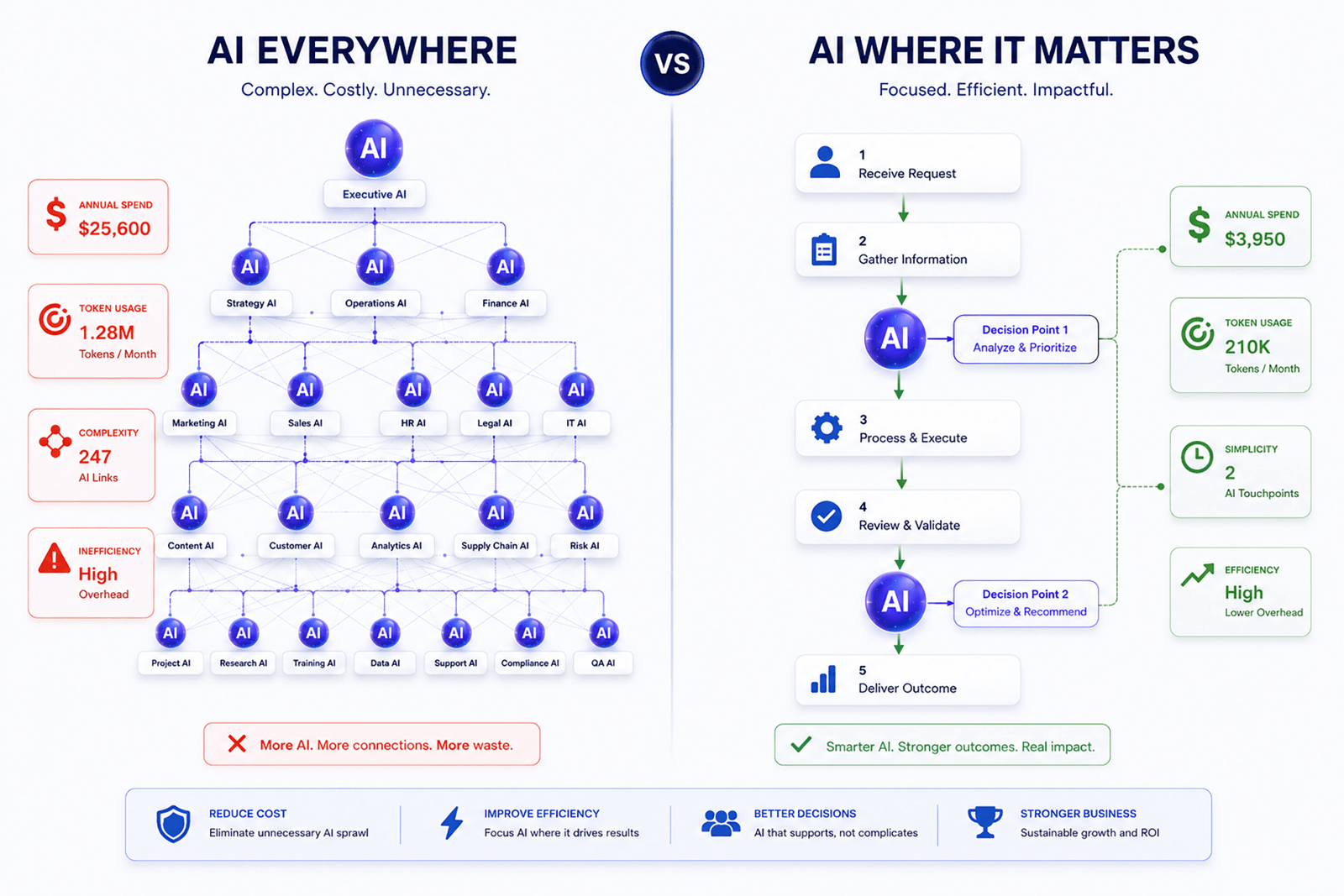
Agent swarms copy an org chart and skip the process underneath. Map the work, put agents where decisions get made, and measure what they cost.
There’s a type of video doing the rounds where someone will show you the ‘company’ they built out of AI agents. It’s a complete org chart with every box filled by an AI Agent. A chief operating officer agent at the top, it has six agents reporting to it, and each of those has their own team of agents doing all the work. You describe what you want, and the structure supposedly handles the rest. If you run a business and one of those videos made you feel behind, you can let that go and not worry about it again. Those videos are targeted at people who want to start their own business, made by people who have never run a paper route successfully, let alone a cashflow postive organisation. Those setups copy the idea of an organisation, not the thing that makes one work. The reporting line isn’t what produces the output, the process underneath it is, and almost nobody building these agent swarms has mapped, let alone designed one.
That distinction used to be an argument about theory. Now it turns up on the invoice.
An org chart isn’t a process
Ask someone who has run a team what the job actually involves and you won’t hear that they tell people what to do and the work appears. It gets done because somebody worked out the steps, wrote them down, trained people on them, and set limits on what each person could decide without checking first. The org chart only tells you who to ask. The process is the business. Skip that and hand an agent an instruction like “go and do the marketing”, and you haven’t delegated anything. You’ve guessed. The agent will produce something, because that’s what it does, every single time you ask. What it can’t do is tell you whether that something was worth producing, because you never described what good looks like. A great example of this is where Bottleneck Labs asked GPT-5.6 Sol to run an App Store business for them. Long story short, they asked the agent to Grow this business as much as possible, now and rather than systematically work through a process backed by data, the agent ended up trying every shortcut possible, leading to the app being free and the only result being a $500 bill.
Boundaries matter as much as the instruction. An agent given a company card and a loose goal will book business class flights to Hong Kong to film content and consider the job well done, because nobody ever told it where the edges were. That isn’t the model behaving badly. It’s a missing process, arriving as a credit card bill.
The bill arrives before the value does
Uber’s chief technology officer recently disclosed that the company burned through its entire 2026 AI coding budget in four months. By March, 84% of its engineers had adopted Claude Code, and around 70% of committed code was coming from AI. Then Andrew Macdonald, Uber’s chief operating officer and president, said publicly that token usage didn’t correlate directly with useful features shipped to users.
Uber isn’t alone. Microsoft told engineers in one major division to stop using an AI coding assistant because the bills had become untenable. One company, reported by Axios, ran up a 500 million dollar Claude bill in a single month after management forgot to set a usage cap. Amazon built an internal leaderboard called KiroRank to track AI use across engineering teams, then quietly took it down once staff started gaming it, burning tokens on meaningless tasks to climb the rankings.
None of that is a technology failure. It’s what happens when consumption gets treated as the result. Roughly 95% of enterprise AI use still runs on the most expensive frontier models, including for work that doesn’t need that much capability, and a study by Faros AI found code churn, meaning lines deleted against lines added, rose by more than 800% under heavy AI adoption. More tokens in, more work thrown away. An MIT study put the economics plainly, finding automation viable in only about 23% of roles. For the other 77%, people are still cheaper.
The cushion is thinning too. Anthropic moved enterprise customers onto usage-based billing tied to actual compute in April 2026, GitHub did the same for Copilot weeks later, and analysts expect enterprise AI bills to rise another 30% to 50% as pricing catches up with real infrastructure costs. Uber and Microsoft can absorb a surprise like that. A smaller Australian business cannot.
Put agents where the decisions get made
Picture a marketing agency in Brisbane we spoke to a couple of weeks ago. They’d stood up a swarm of writer agents under a content lead agent, pointed it at their client list, and let it run for three weeks. It produced a great deal of material. Nobody could say whether any of it was good, nobody knew what a single piece cost to make, and nobody could connect the dots from where each client’s brand was supposed to be focusing content, to where the agents were creating articles.
What changed wasn’t the agents. It was mapping one process from end to end, from a client brief arriving to a campaign plan going out for approval. Written down, that process had eleven steps, and only two of them involved a real decision or an interpretation of information. Which of the client’s audiences this campaign speaks to, and whether the draft matches the client’s tone closely enough to send. Everything else was collecting, formatting, and routing. Those two decisions are where an agent earns its keep, which is the sort of work AI agents for professional services are suited to. You put one at each decision point and give it the context a person would have had, meaning the client’s past campaigns, the brand voice/rules, the audience data, and a clear limit on what it can decide alone. Anything outside that limit stops and asks. Getting those boundaries right is most of the build, and it’s why AI agents work starts with the process rather than the model.
Then you measure, which is the part the Agent Org Chart skips entirely. How many runs finished without a person stepping in, what a completed run costs, how many hours came back to the team, and how often the output went out as written. Anyone telling you to build an org chart of agents almost certainly can’t answer those about their own setup, which tells you most of what you need to know. A couple of honest limits sit inside this. Agents don’t repair a process nobody has written down, they just spend money on it faster and make the mess easier to see. Someone in your business also still owns whether the output is good enough for a client, because that’s a commercial judgement rather than a technical one. And if those agents touch client information, your obligations under the Privacy Act 1988 stay with you, not with whoever sold you the model.
What this means for you
The businesses that get real value out of AI agents over the next few years won’t be the ones running the most agents. They’ll be the ones who wrote down how their work actually happens, put a model at the two or three points where judgement is needed, drew the boundaries around it, and kept count of what it cost and what it returned. That’s slower than filming yourself building a pretend company in an afternoon, but it’s the only version that still looks sensible when the invoice arrives.
If you’re weighing this up, start with a process you already run every week rather than a structure you saw on a screen. Take our AI Roadmap Interview and talk through where your team loses the most time and what a good result actually looks like. You’ll get a plan built around your work, with the boundaries and the measures agreed before anything starts spending.