
AI that runs on your data, inside your own walls
What we build
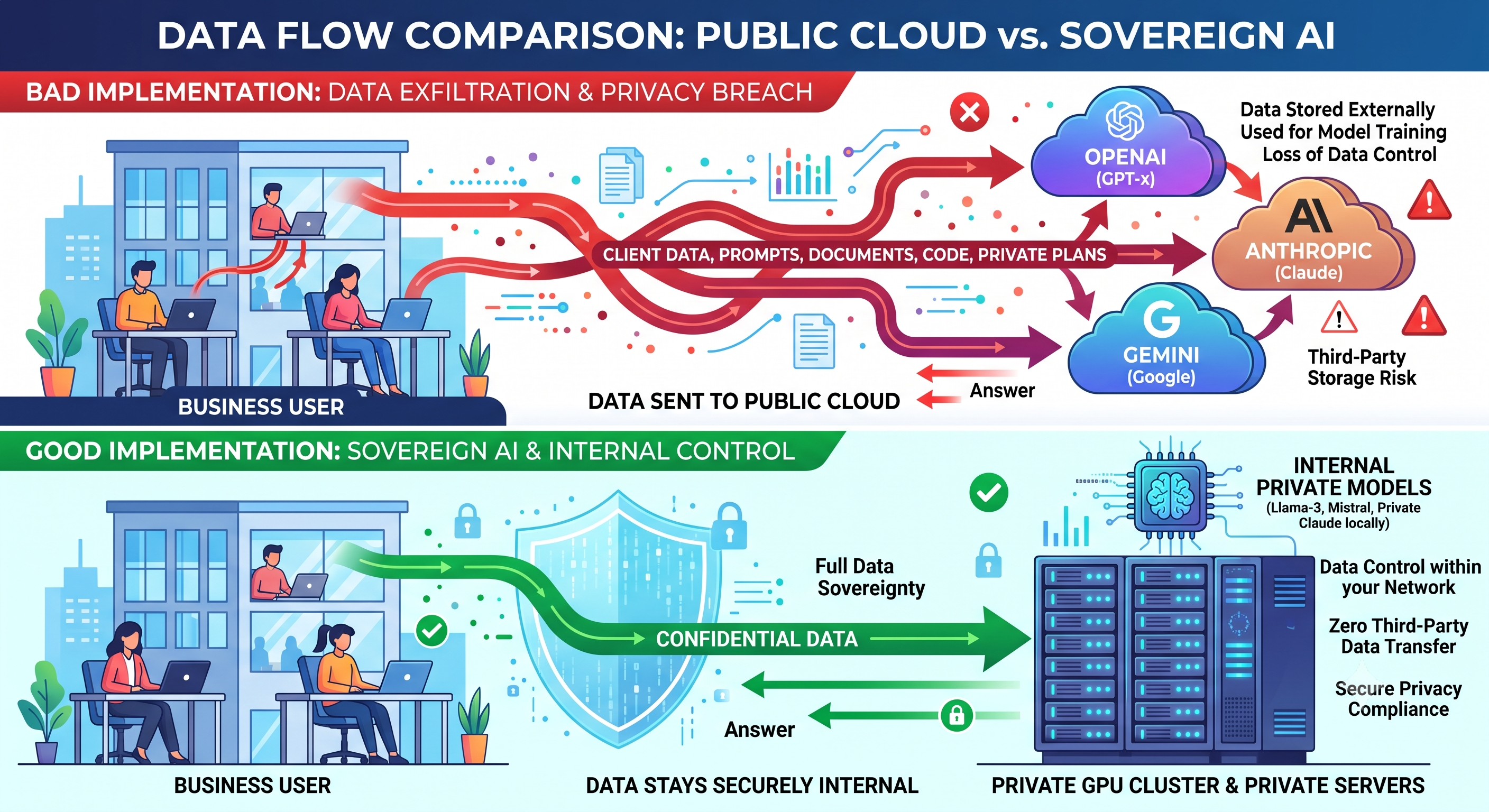
Your data is your edge, and most AI tools ask you to send it somewhere else to get any use out of it. That's fine for general questions. It's a problem the moment client records, pricing, or anything confidential goes into a system you don't control. Sovereign AI is the other option: capable AI that runs on your own infrastructure, grounded in your own data, so the information never leaves your walls. You pick the model, you control how it behaves, and you can move to a cheaper one when it makes sense instead of being tied to one supplier's prices. For a regulated or competitive business, that control is the point. We help you work out which work belongs in-house, stand up the models to run it, and put the rules and data residency around it, so you get the productivity without handing your edge to someone else.
Book a discovery call 
What sovereign AI is, and what it isn’t
Sovereign AI has a plain meaning under the jargon. It’s AI that runs on infrastructure you control, using models you can hold and change, grounded in data that never leaves your business. The opposite is the default most teams fall into, where every question and document is sent to an outside provider’s model and you take their word on what happens to it after that.
What it isn’t is a weaker version of the big public tools. Open models you run yourself are capable enough for the vast majority of business work, and pointed at your own data they often do that work better than a larger public model guessing from the open web. Sovereign doesn’t mean settling for less. It means the capability sits where you can govern it.
It also isn’t only for governments and banks. The Palantir and NVIDIA deals make headlines because of who’s involved, but the reason behind them, keeping your data and your edge under your own control, applies to any business with information worth protecting. A thirty-person firm can run a small open model in-house at a cost that surprises people.
Where you’re stuck
You already know AI can help, but the moment you look closely the risk shows up. Half your team is probably using public chat interfaces already, pasting in whatever they need to get the job done, and nobody has written down what’s allowed. Client files, contracts, and pricing are leaving the building without a record. Meanwhile the tools you’re told to buy all point the same way, toward sending more of your data to someone else’s model and paying more as you use it more. You want the productivity. You don’t want to give away the very thing that makes your business yours, and right now those two pull against each other.
Why buying a tool alone under-delivers
A subscription to a public model is a starting point, not control. Three things separate AI you actually own from AI you just rent, and none of them come with a licence.
Your data has to stay yours. The value of AI on your business comes from feeding it your real information, but that’s exactly the data you can’t afford to leak. So we run the model inside your perimeter, on your own servers or a private Australian cloud region, and ground it in your documents there. Your records inform the answers without ever leaving your control.
You have to be able to change models. When you build everything around one supplier’s product, you inherit their prices, their changes to how the model behaves, and their decision to retire the version you relied on. We keep your data, prompts, and workflows separate from any single model, so swapping to a cheaper or better open one is a change you choose, not a rebuild you dread.
A person has to stay accountable. Sovereign doesn’t mean automated past the point of judgement. We build these systems so the model does the work and a person signs off on anything that carries weight. That’s what keeps you safe on the days the model gets something wrong.
These are the foundations we insist on. You can read more about them in our approach.
How we deliver it
We work in small, reviewable steps rather than one big switch-on, so you keep control and see value early.
- Map where your data goes. We find out how AI is already used across your team and which information must never leave your systems. The honest picture is never zero.
- Pick the work that belongs in-house. We separate the sensitive, high-value jobs worth running on your own model from the low-risk tasks that public tools can keep handling.
- Stand up the model. We deploy an open-weight model on your infrastructure or a private Australian region, sized to the job and your hardware.
- Ground it in your data. We connect it to the right documents and systems, with access scoped so people only reach what they’re cleared to see, and answers cite your material.
- Set the rules and keep a human in the loop. We write a plain usage policy, configure retention and residency, and put approval steps where decisions matter. Every choice is documented and versioned.
Use cases and outcomes
The point of sovereign AI is capability you can measure without giving up control, so we set the metric and the baseline before we build. The wins usually look like one of these. Staff get instant answers from your own policies and records instead of interrupting each other or guessing. Confidential documents get drafted and summarised in-house, so nothing sensitive goes near an outside account. Your AI running costs become a predictable line you own rather than a metered bill that climbs with every use. And the knowledge that makes your business valuable stays inside it. “It’s working” should show up in the numbers, and in what’s no longer leaving the building.
Sovereign AI is one point on a deployment spectrum, from cloud to hybrid to fully air-gapped. If you’d rather someone owned that whole decision and ran it for you, it sits inside a full Technology Partner engagement, where we run your technology on Units and keep you on the current best model without tying your data to it.
Sovereign AI by industry
Control matters differently across sectors. See it applied in FinTech & Banking, Healthcare, Insurance, Legal and Professional Services.
What we build
Private and on-premises model hosting
Open-weight models running on your own servers or a private Australian cloud region, so your data stays inside your perimeter and under your control.
Data grounding inside your walls
The model connected to your own documents and systems through retrieval, so answers come from your material and cite it, without that material ever leaving the building.
Air-gapped and restricted deployments
For the most sensitive work, models that run with tight or no external connection at all, so nothing sensitive can travel outside your environment.
Model choice and swap
The right open model picked for each job, kept separate from your data and workflows, so you can move to a better or cheaper one without a rebuild.
Governance, residency, and audit
Plain usage rules, access controls, retention and residency settings, and an audit trail, configured to sit within your obligations under the Privacy Act.
Related solutions.


Frequently asked.
What is sovereign AI?
Is sovereign AI only for governments and big companies?
Is a self-hosted open model as good as ChatGPT or Gemini?
Does sovereign AI help us meet the Privacy Act?
Is running our own AI model expensive?
Can we still use public AI tools as well?
How do we stop staff leaking data into public chat intefaces?
How do we get started with sovereign AI?
Talk to us about bringing AI in-house
Tell us where your data is most exposed and which work you'd rather keep under your own roof. We'll help you choose the job most worth bringing in-house, and tell you straight if a governed public tool would serve you better.
Book a discovery call