

Sovereign AI for Management Consulting and Advisory Firms
Sovereign AI for Management Consulting and Advisory Firms.
The instinct in most firms is to reach for whatever public AI tool everyone's talking about. In a practice that bills judgement and carries its reputation on every engagement, that instinct is where the risk starts. Every time a consultant pastes a client brief or an engagement file into an outside chat interface, confidential material leaves your control and lands with a provider you can't see. Sovereign AI is the answer to that. It runs capable open models on your own infrastructure, grounded in your own frameworks and engagement files, so the confidential material that is also your firm's edge never leaves the building. You keep control of the model, the cost, and who can see what. The judgement still belongs to a qualified consultant. Sovereign AI makes sure the preparation happens without your client's trust, or your confidentiality, leaving the room.
Book a discovery callWhere sovereign AI earns its keep in a firm
In-house drafting from your own frameworks
A model running inside your walls drafts first-cut analysis, client reports, and slides from your own frameworks and prior engagements, so a consultant edits rather than starts cold and no client material touches an outside service.
Private research across your engagements
Search and summary over your own prior work and client files, on a model you host, so a junior consultant finds relevant material in seconds without any of it leaving the firm.
Confidentiality by design
Because the model runs in your environment, client material stays behind your information barriers, with engagement-level access and logging, so confidentiality holds and you can show who saw what.
Model control and predictable cost
You pick the open model, control how it behaves, and swap to a cheaper one when it suits, turning a metered per-use bill into a cost you own rather than one that climbs with every consultant.
Where your client data actually goes
Sit with a consultant for a day and the pattern is the same in most firms. The advice itself takes minutes. The hours go on the work around it, reading a long client brief to find the three points that matter, drafting the first version of a report you’ve produced a hundred times, and hunting for a framework or deck a partner built two years ago. Somewhere in that day, to get through it faster, someone opened a public chat interface and pasted in a client document. They meant no harm. They were just trying to clear the pile.
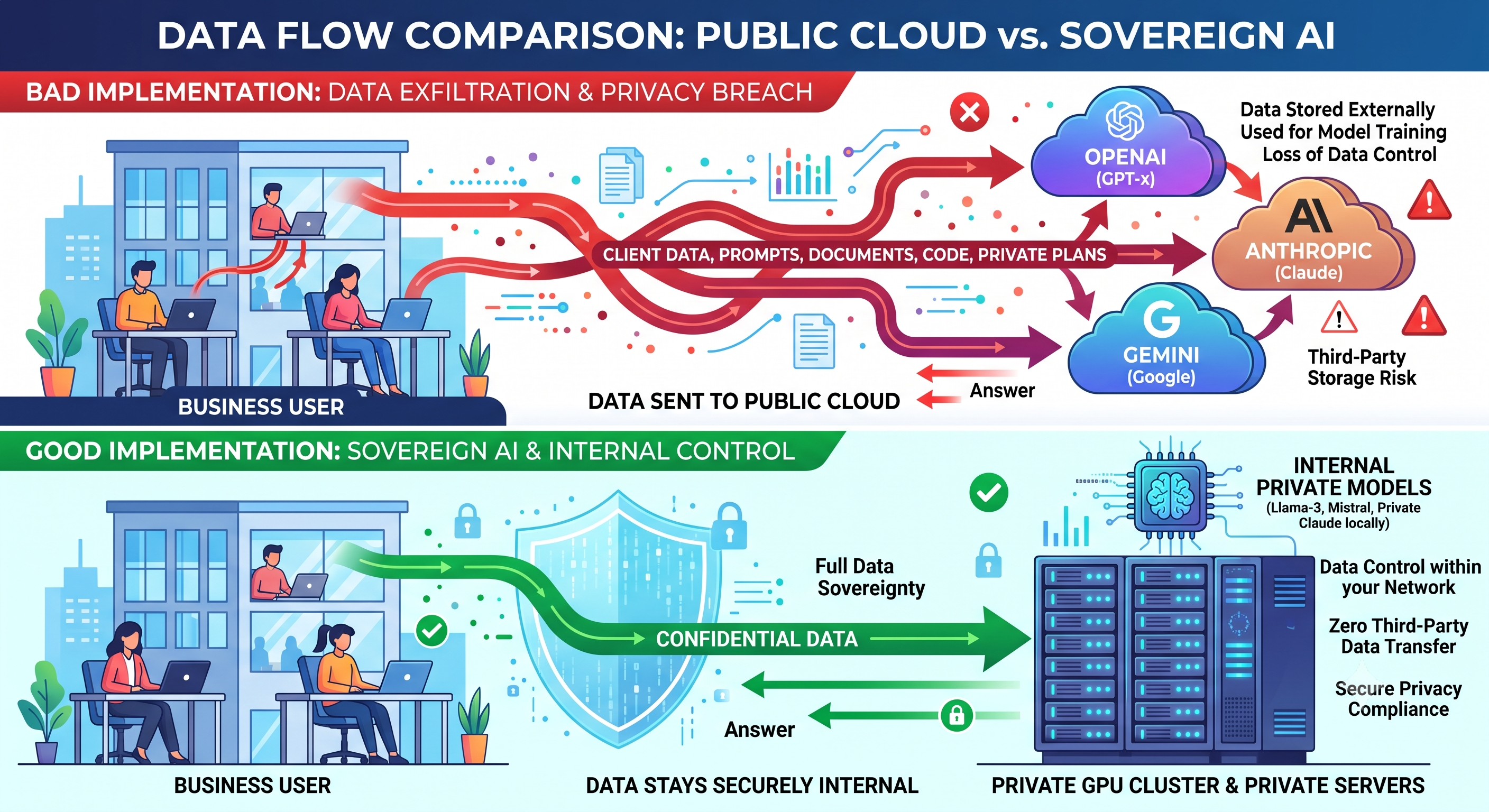
That’s the moment worth stopping on. In a firm that bills judgement and carries its reputation on every engagement, the real risk was never that a model can’t read a client brief. It’s that the material is confidential, and it’s also the thing that makes your firm valuable. The second it lands with an outside provider you can’t see, you’ve put both your client’s trust and your own edge somewhere you don’t control. The honest position is that this has probably already happened in your firm, quietly, without anyone logging it. Sovereign AI exists to give your people the speed they were reaching for, without the material leaving the building to get it.
Why a public chat interface under-delivers here
A generic assistant knows the public internet, not your framework library, your client database, or your engagement files. Ask it to draft a recommendation and it returns a plausible average of every recommendation online, which is exactly the wrong thing in a practice where the specific analysis carries your name. Worse, feeding it a client’s document to do so sends confidential material to a third party. In most businesses that’s a quality problem. In a consulting firm it’s a trust and confidentiality problem.
The fix isn’t a better prompt. It’s running the model where the data stays. When a capable open model runs inside your environment, grounded in your own files, it drafts from your framework rather than a stranger’s, and the client material never leaves your control to make that happen. That grounding is principle #5 on AI-accessible internal data, and the security and governance that keep the material walled off is another of the foundations in our approach. Its prompts, tools, and decisions are version-controlled, so the trail of how a draft was produced is recorded and auditable, which is principle #6 on documented, version-controlled process. Buying a subscription gives you none of these. Building them in is the work.
How we deliver it for a firm
We start with one bounded task and prove it against work your team has already completed, before it goes anywhere near a live engagement. We run the model inside your environment, on your own infrastructure or a private Australian region, so client data stays where confidentiality depends on it staying. We measure how often the tool is accurate, where it fails, and what it costs to run, so the decision to roll it out rests on numbers rather than a good demo.
We design around your obligations from the first day, not as a later addition. Client material stays behind your information barriers, access is scoped to the engagement and logged, and nothing is sent to an outside service without your agreement. We build to your duty of confidentiality, the terms of your engagement letters and NDAs, and the Australian Privacy Principles. We’re careful here and make no regulatory promises on your behalf, because in this sector the responsibility for compliance stays with the firm and its principals. Running the model in-house makes that responsibility easier to discharge, because the material never leaves and the audit trail is clean.
When sovereign AI is the right call, and when it is not
Sovereign AI is a good fit when the data is sensitive or confidential, the use is steady, and you want control over the model and its cost. That describes most firms, and running the model on your own infrastructure is what keeps the confidential work confidential. It’s also the answer when your running costs are climbing with every consultant on a metered public tool.
It’s the wrong call when you’d be standing up infrastructure to handle a handful of low-risk, non-confidential questions a week. For that, a governed public tool is often the simpler and cheaper choice, and we’ll say so plainly rather than sell you a setup you don’t need. Most firms end up with a sensible mix, the confidential work kept in-house and the general tasks on a sanctioned public tool. We help you draw that line in the right place.
We work with management consultants and advisory practices across Brisbane, Sydney, and Melbourne, and we build for Australian rules rather than transplanting an overseas tool. To see the broader service, read Sovereign AI. For the models behind it, see open-weight models. For the sector view, see Professional Services. And for the foundations behind every build, see our approach.
Read more about our Sovereign AI service and our work in Professional Services sector.
Representative solutions.



Frequently asked.
Is it safe to use AI on confidential client material?
Can we run AI without sending client data to OpenAI or Google?
Is a self-hosted model good enough for consulting work?
Does sovereign AI help us meet our confidentiality and Privacy Act duties?
Is running our own AI model realistic for a small firm?
How do we start with sovereign AI in our firm?
Keep the prep in-house and the confidentiality intact
Tell us where your consultants lose the most time, and which client material must never leave the firm. We'll tell you whether sovereign AI is a safe and sensible fit, or whether a simpler change would do more.
Book a discovery call