Where you’re stuck with model choice
Most businesses meet AI through one product. Someone signs up for ChatGPT or Gemini, it works, and before long the whole team’s data flows through one company’s model on that company’s terms. It’s convenient right up until you notice what you’ve given away. Your confidential information passes through a system you can’t see, your bill climbs with every extra user, and the day the provider changes the model or its price, you have no say.
The reflexive question is still “which AI tool should we buy”, as though the answer were a single product with a clear winner. That’s the wrong question, and it’s why so many businesses feel stuck with a tool they don’t control. The more useful question is whether you’re set up so that almost any model could run on your own data, safely and cheaply. Answer that, and the model itself stops being a lock-in and starts being a choice.
Why downloading the model doesn’t finish the job
It’s tempting to think open-weight models are a simple swap. Download a capable model, run it, and stop paying a subscription. The model really is the cheap and easy part now. Families like Meta’s Llama, NVIDIA’s Nemotron, Mistral, and Alibaba’s Qwen are free to download and strong enough for most business work. But a raw model knows the public internet, not your business. Ask it your refund window or your standard rates and it invents a plausible average that someone has to catch.
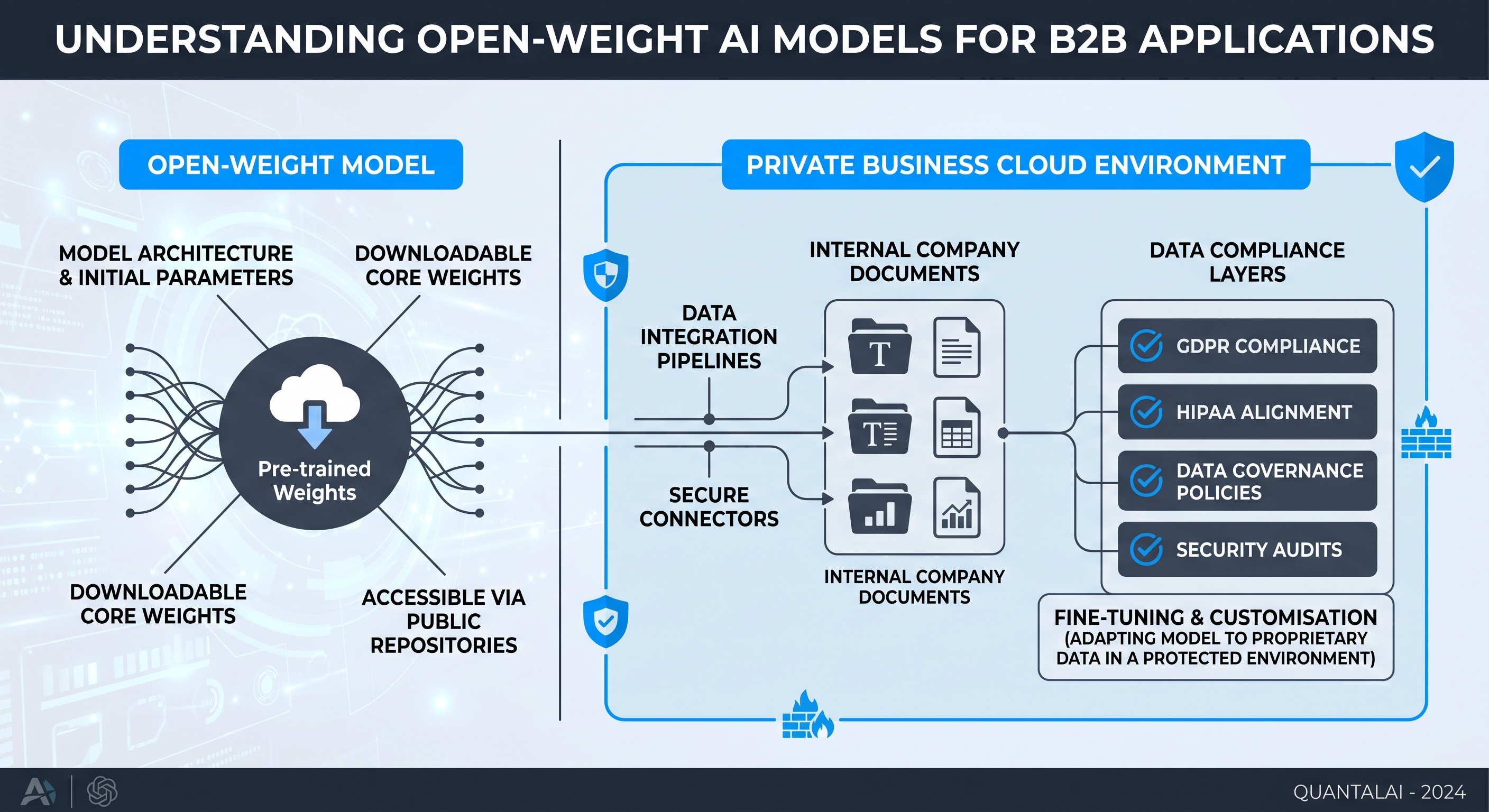
The work that makes an open model pay off is everything around it. It has to run somewhere your data stays put, whether that’s your own servers or a private Australian cloud region. It has to be connected to your documents so its answers come from your material with a source attached. And it needs the rules and access controls that decide who can ask what. Sending data to any model raises real questions under the Privacy Act about where that data lives and who can read it. An open model you host yourself is the cleanest answer to those questions, but only once it’s set up with care. The download is step one of many.

How we deliver it
We start by matching the model to the job, because the right open model for a legal summariser isn’t the one for a customer-service agent.
- Pick the model for the task. We choose from the open families based on your job, your hardware, your budget, and your data rules, and we write down why.
- Host it where your data stays. We deploy on your own infrastructure or a private Australian region, so nothing leaves your perimeter.
- Ground it in your documents. We connect the model to the files and systems that hold your answers, with access scoped to who’s allowed to see what.
- Adapt it where it pays. Where a job is repetitive and high-value, we fine-tune the model on your examples and terminology so the output fits your business.
- Keep you portable. We keep your data, prompts, and workflows separate from any one model, so moving to a better or cheaper one later is a decision, not a rebuild. Every choice is documented and versioned.
When an open-weight model is the right tool, and when it’s not
An open-weight model fits when control matters: sensitive data, steady high-volume use, predictable costs, or a real need to avoid being tied to one supplier. Run on your own infrastructure and grounded in your data, it gives you capability that stays inside your business.
It’s the wrong tool when you’d be standing up a data centre to answer a handful of questions a week. For light, general use with non-sensitive data, a governed public tool like ChatGPT is often the simpler and cheaper call, and we’ll say so. The honest position is that most businesses end up with a mix: open models for the work that must stay private, public tools for the rest. We help you draw that line in the right place rather than selling you one answer for everything.
Where this fits with the rest of your stack
Choosing and hosting a model is one piece of a bigger picture. To put a model to work inside your business, see sovereign AI and AI agents. To connect it to your systems, look at integration services. For a governed public option alongside it, see ChatGPT. For sector work, see professional services and FinTech & Banking.